Seated Woman
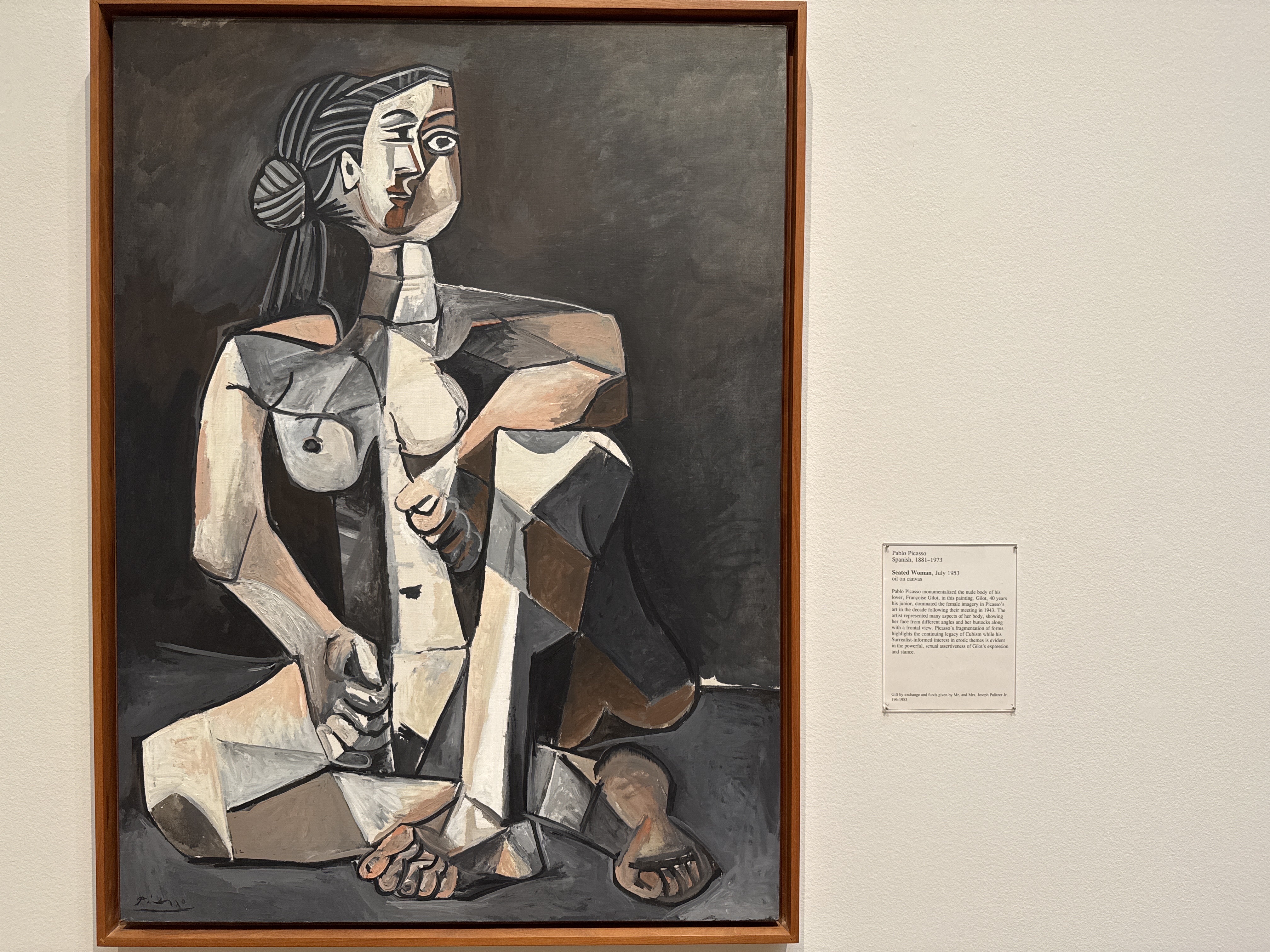
This is a painting by Pablo Picasso from 1953. It shows a woman sitting, but her face and body are broken into shapes and seen from different sides at once.
What do you see?
Look at the painting. You see a woman sitting in a chair. But her face is made of flat shapes — a triangle for a nose, a circle for an eye. Her body is also made of blocks and lines. The colors are soft: pinks, blues, and grays. She looks calm, but her body is twisted in a way that isn't real.
Look closely
- Can you find two eyes on the same side of her face? Why do you think Picasso did that?
- Look at her hands. Are they the same size? What does that make you think?
- What colors do you see most? How do they make you feel?
- Trace the lines that outline her body. Are they straight or curved?
- Imagine you are sitting in the same pose. Does it feel comfortable or strange?
Style and technique
This painting is an example of Cubism, an art style invented by Picasso and Georges Braque around 1907. In Cubism, artists break objects into geometric shapes and show them from many viewpoints at the same time. Instead of painting a realistic face, Picasso painted a face that you can see from the front and the side all at once. He also used oil paint on canvas. The colors are muted, which gives the painting a quiet, thoughtful mood.
Feeling
The woman in the painting looks calm and thoughtful. Her eyes are open, but she seems to be looking inward. Picasso often used distortion to show emotions. The soft colors and relaxed pose suggest a peaceful, maybe even sad, feeling. Many art critics say this painting reflects Picasso's own complex emotions at the time.
Connections
Try this
- Draw a picture of a friend using only shapes like triangles, squares, and circles. Try to show their face from two sides at once.
- Look at a mirror. Can you see your face from the side and the front at the same time? Why not?
- Find another Cubist painting. Compare it to this one. What is similar? What is different?
Next to find
- Find another painting by Picasso. How is it different from this one?
- Look for a Cubist sculpture. How does it use shapes?
- Find a painting from the same year (1953) by a different artist. Compare the styles.
坐着的女人
这是巴勃罗·毕加索1953年的一幅画。它展示了一个坐着的女人,但她的脸和身体被分解成形状,同时从不同的侧面看到。
你看到了什么?
看这幅画。你看到一个女人坐在椅子上。但她的脸是由扁平的形状组成的——一个三角形鼻子,一个圆形眼睛。她的身体也由方块和线条组成。颜色柔和:粉色、蓝色和灰色。她看起来很平静,但她的身体以一种不真实的方式扭曲着。
仔细看
- 你能在她脸的同一侧找到两只眼睛吗?你认为毕加索为什么这样做?
- 看她的手。它们一样大吗?这让你想到什么?
- 你看到最多的颜色是什么?它们让你感觉如何?
- 勾勒她身体的线条。它们是直的还是弯曲的?
- 想象你以同样的姿势坐着。感觉舒服还是奇怪?
风格与技法
这幅画是立体主义的一个例子,立体主义是毕加索和乔治·布拉克在1907年左右发明的一种艺术风格。在立体主义中,艺术家将物体分解成几何形状,并同时从多个视角展示它们。毕加索没有画一张写实的脸,而是画了一张你可以同时从正面和侧面看到的脸。他还使用了油画颜料在画布上。色彩柔和,给这幅画带来一种安静、沉思的氛围。
感受
画中的女人看起来平静而沉思。她的眼睛睁着,但似乎在内省。毕加索经常用变形来表现情感。柔和的色彩和放松的姿势暗示着一种平和,甚至可能悲伤的感觉。许多艺术评论家认为这幅画反映了毕加索当时复杂的情感。
关联
试试这个
- 只用三角形、正方形和圆形等形状画一个朋友的画。尝试同时从两个侧面展示他们的脸。
- 看镜子。你能同时看到脸的侧面和正面吗?为什么不能?
- 找另一幅立体主义画作。与这幅比较。有什么相似?有什么不同?
接下来找找看
- 找另一幅毕加索的画。它与这幅有什么不同?
- 寻找一件立体主义雕塑。它如何使用形状?
- 找一幅同一年(1953年)由不同艺术家创作的画。比较风格。