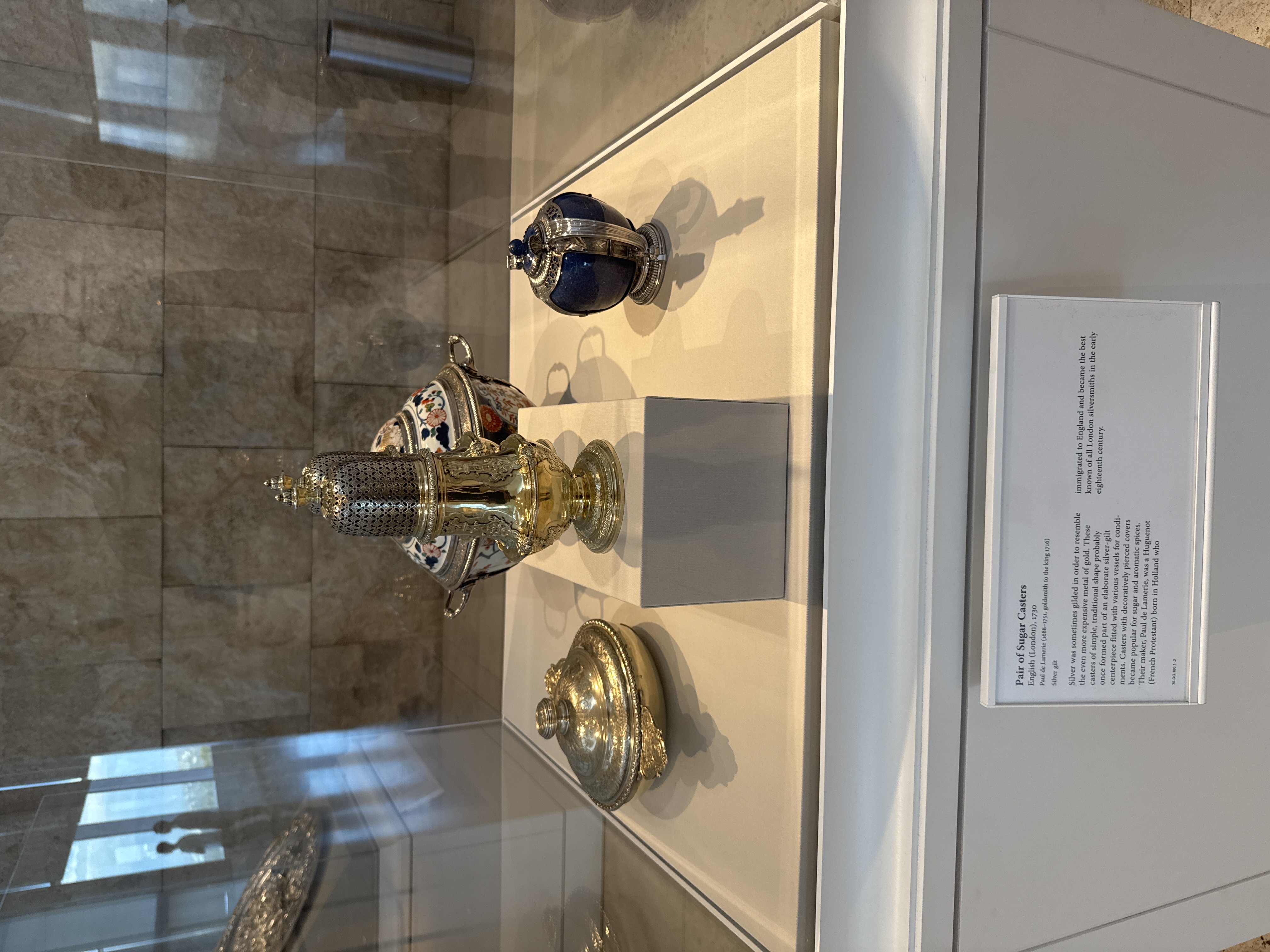
Silver Sugar Sifters by Paul de Lamerie
These are a pair of silver sugar sifters made in London around 1720 by the famous silversmith Paul de Lamerie. They were used to sprinkle sugar on food and were a sign of wealth and luxury.
What is it?
These are two silver sugar sifters, also called sugar casters. They have a body with a perforated top, so you can shake sugar onto your food. They were made in London, England, in the early 1700s. The maker was Paul de Lamerie, a very famous silversmith. He was born in the Netherlands to French Protestant parents and moved to London, where he became one of the most skilled silversmiths of his time.
Who used it?
Wealthy families used these sugar sifters on their dining tables. Sugar was an expensive luxury in the 1700s, so only rich people could afford to sprinkle it on their food. The sifters were part of a set of silver tableware that showed the family's wealth and good taste.
When and where?
These sugar sifters were made in London around 1720. London was a busy city with many skilled craftspeople. Paul de Lamerie worked there, making beautiful silver objects for rich customers.
What does it tell us?
These sugar sifters tell us that in the 1700s, wealthy people liked to show off their riches with fancy silver objects. They also tell us that sugar was a prized luxury item. The fact that the sifters were sometimes gilded (covered with a thin layer of gold) shows that people wanted their silver to look even more precious.
Compared to today
Today, we use simple plastic or metal sugar shakers. But in the 1700s, even a simple thing like a sugar shaker was made of silver and beautifully decorated. That's because back then, only the rich could afford sugar, and they wanted to show off.
Connections
- Paul de Lamerie
- London, England
- Silver
- Metalworking
- Gilding
- Luxury
- Art and Everyday Life
- Early 18th Century
Next to find
- Find another object made by Paul de Lamerie.
- Look for a sugar sifter from a different country or time period.
- Find an object that was gilded (covered with gold).
保罗·德·拉梅尔制作的银糖洒器
这是一对大约1720年在伦敦由著名银匠保罗·德·拉梅尔制作的银糖洒器。它们用来在食物上撒糖,是财富和奢华的象征。
这是什么?
这是两个银糖洒器,也叫糖罐。它们有一个带孔的盖子,可以摇动将糖撒在食物上。它们于18世纪初在英格兰伦敦制作。制作者是保罗·德·拉梅尔,一位非常著名的银匠。他出生于荷兰,父母是法国新教徒,后来移居伦敦,成为当时最出色的银匠之一。
谁使用了它?
富裕的家庭在餐桌上使用这些糖洒器。在18世纪,糖是一种昂贵的奢侈品,所以只有富人才能负担得起在食物上撒糖。这些糖洒器是一套银制餐具的一部分,展示了家庭的财富和品味。
何时何地?
这些糖洒器大约于1720年在伦敦制作。伦敦是一个繁忙的城市,拥有许多熟练的工匠。保罗·德·拉梅尔在那里工作,为富有的客户制作精美的银器。
它告诉我们什么?
这些糖洒器告诉我们,在18世纪,富人喜欢用精美的银器来炫耀他们的财富。它们还告诉我们,糖是一种珍贵的奢侈品。这些糖洒器有时会被镀金(覆盖一层薄金),这表明人们希望他们的银器看起来更加珍贵。
与今天比较
今天,我们使用简单的塑料或金属糖罐。但在18世纪,即使是像糖罐这样简单的物品也是用银制成并精美装饰的。那是因为当时只有富人买得起糖,他们想要炫耀。
联系
接下来寻找
- 找另一件保罗·德·拉梅尔制作的物品。
- 寻找来自不同国家或时期的糖洒器。
- 找一件镀金的物品。