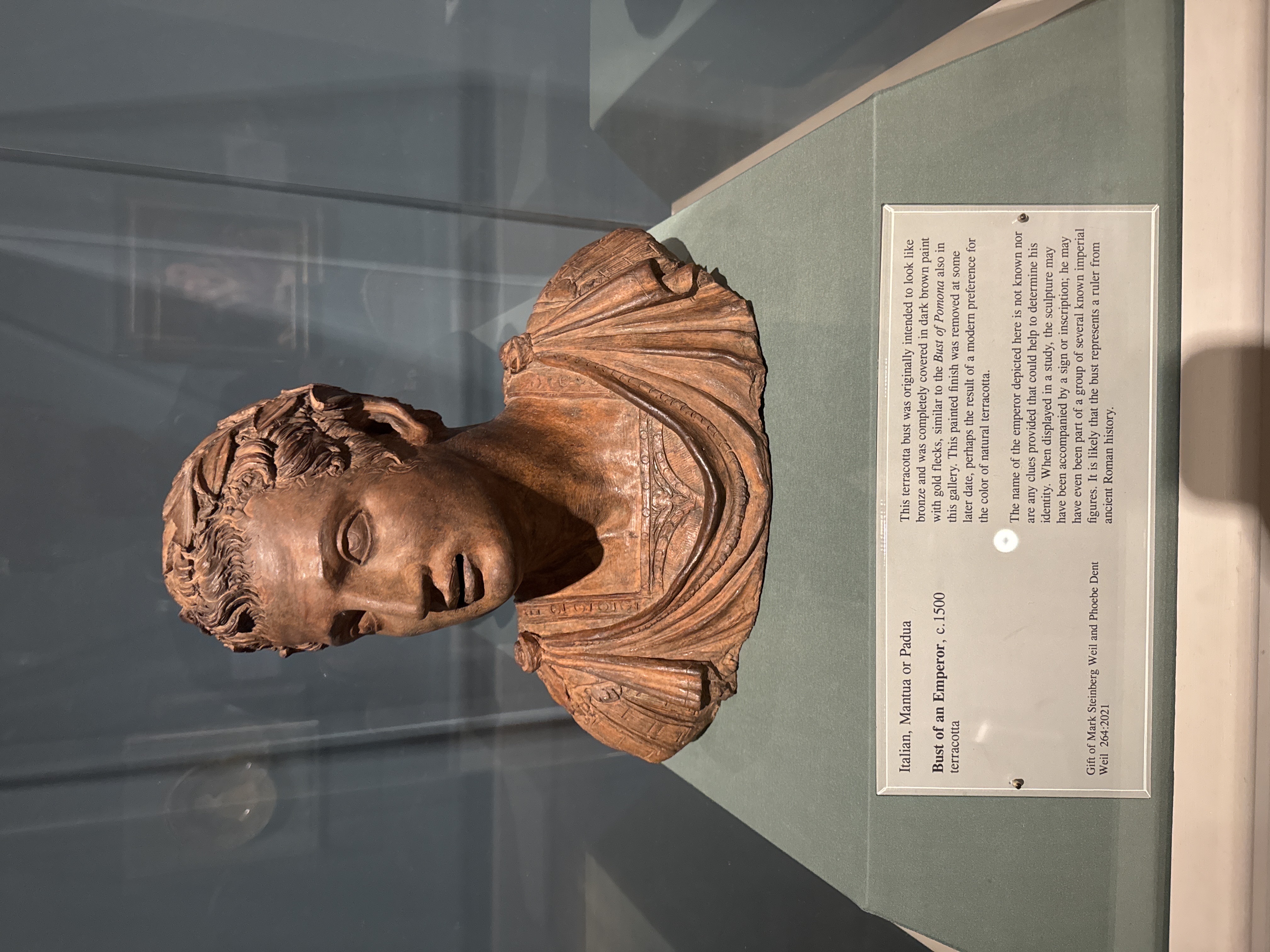
Terracotta Bust of an Unknown Roman Emperor
This is a clay bust of a Roman emperor, made around 1500 in Italy. It was originally painted to look like bronze, but the paint was later removed.
What is it?
This is a terracotta bust of a Roman emperor. Terracotta is a type of clay that is baked in a kiln. The bust was made around 1500 in Mantua or Padua, Italy. It was originally painted with a dark brown varnish and gold spots to make it look like a bronze statue. Later, someone removed the paint, perhaps because they preferred the natural clay color.
Who used it?
We don't know exactly who used this bust. It was probably made for a collector or a scholar who admired ancient Roman history. During the Renaissance, many people in Italy collected Roman artifacts or made new artworks in the Roman style.
When and where?
The bust was made around 1500 in either Mantua or Padua, two cities in northern Italy. This was during the Renaissance, a time when artists were inspired by ancient Roman art.
What does it tell us?
This bust tells us that people in the Renaissance admired Roman emperors. Even though we don't know which emperor this is, the bust shows how Renaissance artists tried to copy Roman styles. It also shows that artists sometimes used cheap materials like terracotta and painted them to look like expensive bronze.
Compared to today
Today, we might make a copy of a famous statue out of plastic or resin. Back then, they used clay and painted it to look like metal. Both are ways to make art that looks expensive without using costly materials.
Connections
Next to find
- A bronze statue from the same time period to compare the materials.
- Another Renaissance bust that still has its original paint.
- A Roman coin with the emperor's face to see if you can identify the emperor.
无名罗马皇帝的陶土胸像
这是一尊罗马皇帝的陶土胸像,大约1500年在意大利制作。它最初被涂成青铜色,但后来漆被去除了。
这是什么?
这是一尊罗马皇帝的陶土胸像。陶土是一种在窑中烧制的粘土。这尊胸像大约1500年制作于意大利的曼图亚或帕多瓦。它最初被涂上深棕色的漆并点缀金色斑点,以模仿青铜雕像。后来,有人去除了涂漆,也许是因为他们更喜欢陶土的自然颜色。
谁使用它?
我们不确定谁使用了这尊胸像。它可能是为收藏家或欣赏古罗马历史的学者制作的。在文艺复兴时期,意大利的许多人收藏罗马文物或制作罗马风格的新艺术品。
何时何地?
这尊胸像大约1500年制作于意大利北部的曼图亚或帕多瓦。这是文艺复兴时期,艺术家们从古罗马艺术中汲取灵感。
它告诉我们什么?
这尊胸像告诉我们,文艺复兴时期的人们崇拜罗马皇帝。尽管我们不知道这是哪位皇帝,但这尊胸像展示了文艺复兴艺术家如何模仿罗马风格。它还表明,艺术家有时使用廉价的材料如陶土,并涂漆使其看起来像昂贵的青铜。
与今天相比
今天,我们可能会用塑料或树脂复制著名的雕像。那时,他们使用粘土并涂漆使其看起来像金属。两者都是用艺术使物品看起来昂贵而不使用昂贵材料的方法。
关联
接下来寻找
- 同一时期的青铜雕像,比较材料。
- 另一尊保留原始涂漆的文艺复兴胸像。
- 带有皇帝面孔的罗马硬币,看看是否能识别出皇帝。