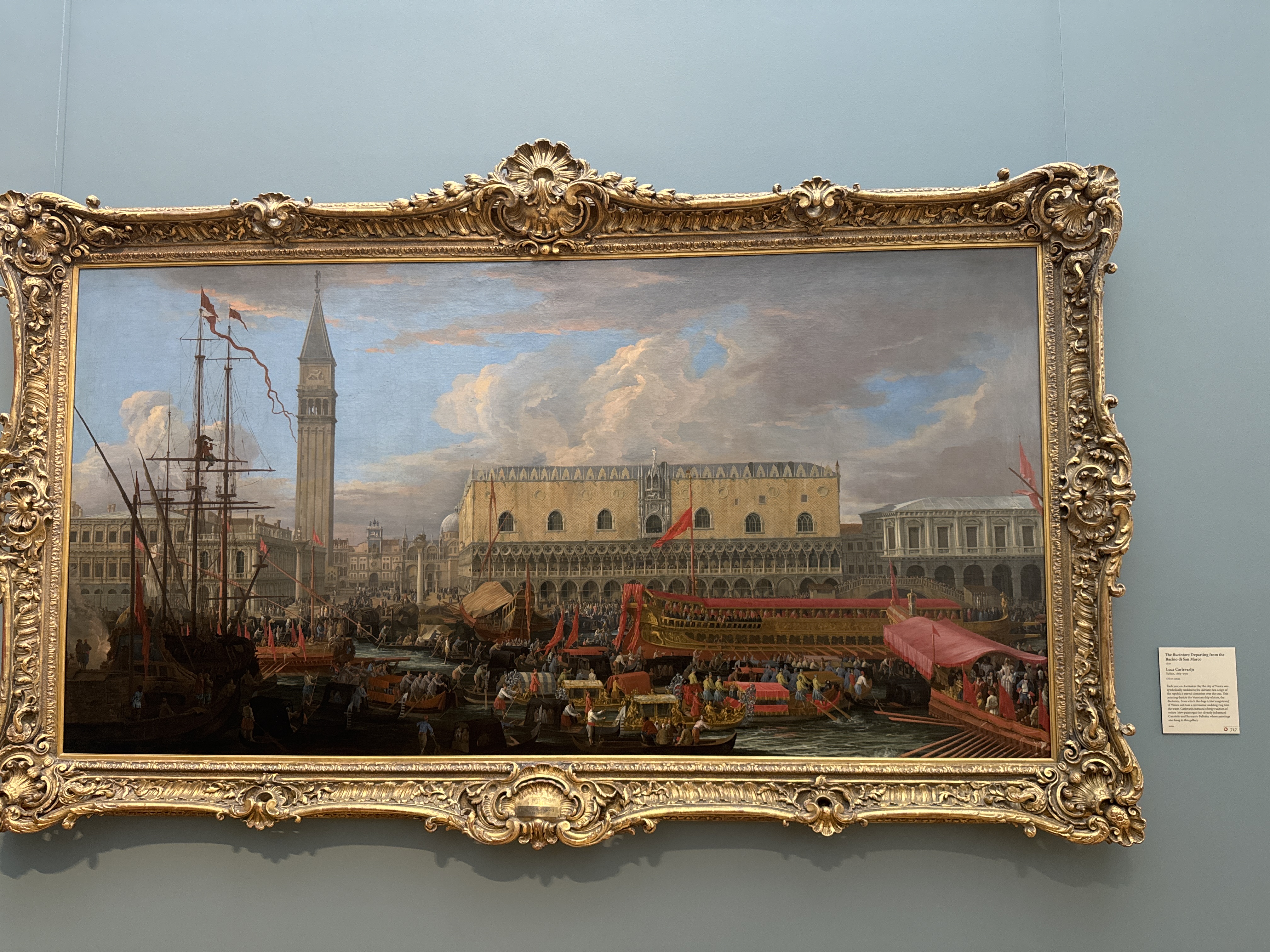
Grand Canal, Venice with St. Mark's Campanile
This painting shows Venice's Grand Canal with many sailboats and gondolas, and famous buildings like St. Mark's Campanile and the Doge's Palace. It was made in the 1700s, when Venice was a busy trading city.
What do you see?
You see a wide canal filled with boats. On the right, there is a tall tower called St. Mark's Campanile. Next to it is the Doge's Palace, a beautiful building with arches. The sky has fluffy clouds, and the water has gentle waves. The artist painted every detail carefully, from the people on the boats to the carvings on the buildings.
Look closely
- How many different kinds of boats can you find? Look for sailboats, gondolas, and small rowboats.
- What colors did the artist use for the sky and water? Do they match or contrast?
- Can you see people on the boats or on the shore? What do you think they are doing?
- Look at the buildings on the left side of the canal. What do you notice about their shapes and colors?
- How does the artist show that the canal is busy and full of life?
Style and technique
This painting is a veduta, which means a detailed city view. The artist used oil paint on canvas to create bright colors and smooth details. The careful way the buildings and boats are painted shows that the artist was very skilled. Paintings like this were popular with wealthy travelers who visited Venice on the Grand Tour.
Feeling
This painting makes you feel like you are standing on the shore of the Grand Canal, watching the busy boats go by. The sky and water look calm, but the many boats show that Venice was a lively and important city. It feels like a sunny, busy day.
Connections
Try this
- Draw your own veduta of a busy street or harbor near you. Include as many details as you can.
- Look at a photo of Venice today. How is it the same or different from this painting?
- Imagine you are a tourist in the 1700s. What would you buy as a souvenir from Venice?
Next to find
- A painting by Canaletto of another Venice scene, like St. Mark's Square
- A gondola or other Venetian boat in a museum
- A modern photograph of the Grand Canal to compare
- Another veduta from a different city, like Rome or London
威尼斯大运河与圣马可钟楼
这幅画展示了威尼斯的大运河,有许多帆船和贡多拉,还有圣马可钟楼和总督府等著名建筑。它创作于18世纪,当时威尼斯是一个繁忙的贸易城市。
你看到了什么?
你看到一条宽阔的运河,挤满了船只。右边有一座高塔,叫做圣马可钟楼。旁边是总督府,一座带有拱门的美丽建筑。天空有蓬松的云朵,水面有轻柔的波浪。画家仔细描绘了每一个细节,从船上的人物到建筑上的雕刻。
仔细看
- 你能找到多少种不同的船?找找帆船、贡多拉和小划艇。
- 画家用了什么颜色画天空和水?它们相配还是相反?
- 你能看到船上或岸上的人吗?你觉得他们在做什么?
- 看看运河左边的建筑。你注意到它们的形状和颜色有什么特点?
- 画家如何表现运河的繁忙和生机?
风格与技巧
这幅画是一幅“风景画”,即细致的城市景观。画家在画布上使用油画颜料,创造出明亮的色彩和光滑的细节。建筑和船只的细致描绘表明画家技艺高超。这类画作深受来威尼斯进行“大旅行”的富有旅行者的欢迎。
感受
这幅画让你感觉仿佛站在大运河岸边,看着繁忙的船只来来往往。天空和水面看起来很平静,但众多的船只表明威尼斯是一个充满活力的重要城市。感觉像一个晴朗、忙碌的日子。
联系
试试这个
- 画一幅你附近繁忙街道或港口的风景画,尽可能多地添加细节。
- 看一张今天威尼斯的照片。它与这幅画有什么相同或不同?
- 想象你是18世纪的游客。你会买什么作为威尼斯的纪念品?
下一步寻找
- 卡纳莱托另一幅威尼斯场景的画作,比如圣马可广场
- 博物馆里的贡多拉或其他威尼斯船只
- 一张现代大运河的照片来比较
- 另一幅来自不同城市(如罗马或伦敦)的风景画