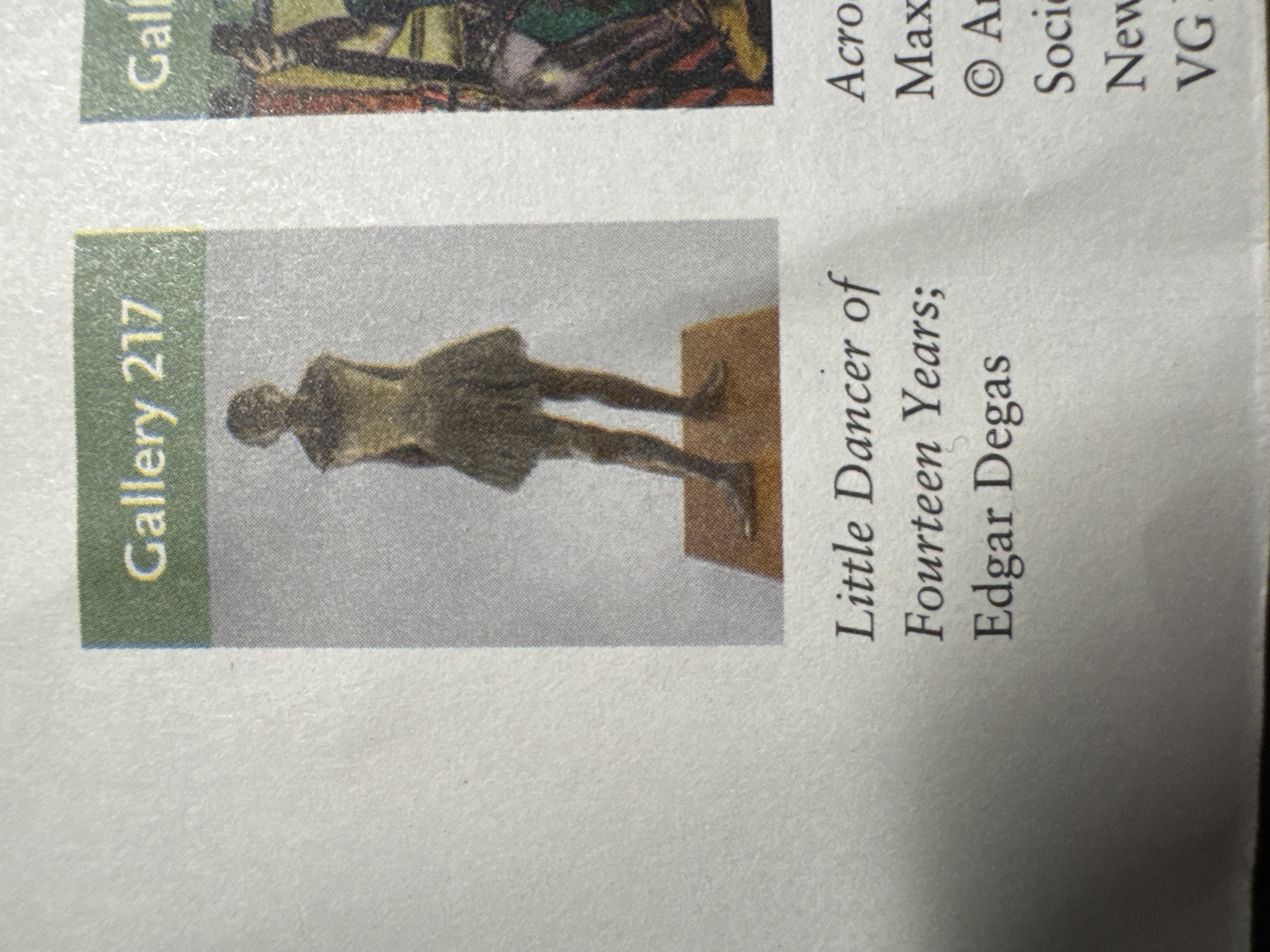
Little Dancer of Fourteen Years
A small statue of a young ballet dancer, made by Edgar Degas. It shows her standing in a relaxed pose, wearing a real fabric tutu and a ribbon in her hair.
What do you see?
You see a young girl standing with her feet apart and her hands behind her back. She wears a ballet tutu made of real fabric, and a ribbon ties her hair back. Her chin is lifted, and she looks a little proud but also tired. The sculpture is made of wax, which gives her skin a soft, lifelike look.
Look closely
- Look at her face. Does she look happy, tired, or something else? What do you think she is feeling?
- Notice the fabric tutu and ribbon. Why do you think Degas used real cloth instead of carving them from wax or bronze?
- Look at her body. Her feet are turned out, and her hands are clasped behind her back. What does this pose tell you about her training?
- The sculpture is small, about the size of a real 14-year-old girl. How does that change the way you see her?
- Compare her to other statues you've seen. Is she more realistic or more artistic? Why?
Style and technique
Degas was an Impressionist, which means he wanted to capture real moments from everyday life. Instead of making a smooth, perfect statue, he used wax to model the girl's face and body with tiny details. He even added real hair and a fabric tutu. This was very unusual at the time — most sculptures were made of bronze or marble and didn't use real clothes. Degas wanted to show the dancer as a real person, not a perfect ideal.
Feeling
This sculpture makes many people feel both admiration and sadness. The girl looks graceful but also tired. You can see the hard work behind her dancing. Degas wanted us to think about the lives of young dancers in Paris, who often worked long hours and faced many challenges.
Connections
- Edgar Degas
- Impressionism
- Ballet
- Sculpture
- Wax
- Fabric
- Performance
- Dance
- Childhood
- Childhood and Labor
Try this
Try making your own sculpture of a person using clay or play-dough. Add fabric for clothes. How does adding real fabric change the way the sculpture feels?
Next to find
- Find another sculpture that uses real materials like fabric or hair.
- Look for other artworks by Edgar Degas, especially his paintings of dancers.
- Find a ballet performance to watch. Notice the dancers' poses and compare them to the Little Dancer.
十四岁的舞者
埃德加·德加创作的一座年轻芭蕾舞者的小雕像。她以放松的姿势站立,穿着真正的布料芭蕾舞裙,头发上系着丝带。
你看到了什么?
你看到一个年轻女孩双脚分开站立,双手背在身后。她穿着真正的布料芭蕾舞裙,一条丝带把她的头发扎在后面。她的下巴微微抬起,看起来有点骄傲,但也有些疲惫。这座雕塑是用蜡制成的,这让她的皮肤看起来柔软而逼真。
仔细观察
- 看看她的脸。她看起来开心、疲惫,还是别的什么?你觉得她在感受什么?
- 注意布料的舞裙和丝带。你认为德加为什么用真布,而不是用蜡或青铜雕刻它们?
- 看看她的身体。她的脚向外打开,双手交握在背后。这个姿势告诉你关于她的训练什么?
- 这座雕塑很小,大约和一个真正的14岁女孩一样大。这如何改变你看待她的方式?
- 把她和你见过的其他雕像比较。她更写实还是更艺术?为什么?
风格与技法
德加是一位印象派艺术家,这意味着他想捕捉日常生活中的真实瞬间。他没有制作光滑完美的雕像,而是用蜡塑造女孩的脸和身体,添加了微小的细节。他甚至加了真头发和布料舞裙。这在当时非常不寻常——大多数雕塑是用青铜或大理石制成的,并且不使用真正的衣服。德加想展示舞者是一个真实的人,而不是完美的理想形象。
感受
这座雕塑让许多人既钦佩又伤感。女孩看起来优雅但也疲惫。你可以看到她舞蹈背后的辛勤工作。德加希望我们思考巴黎年轻舞者的生活,她们常常长时间工作,面临许多挑战。
关联
动手试试
试着用粘土或橡皮泥制作你自己的雕塑。添加布料做衣服。添加真实布料如何改变雕塑的感觉?
下一步寻找
- 找另一件使用真实材料(如布料或头发)的雕塑。
- 寻找埃德加·德加的其他作品,尤其是他画的舞者。
- 观看一场芭蕾表演。注意舞者的姿势,并与小舞者比较。