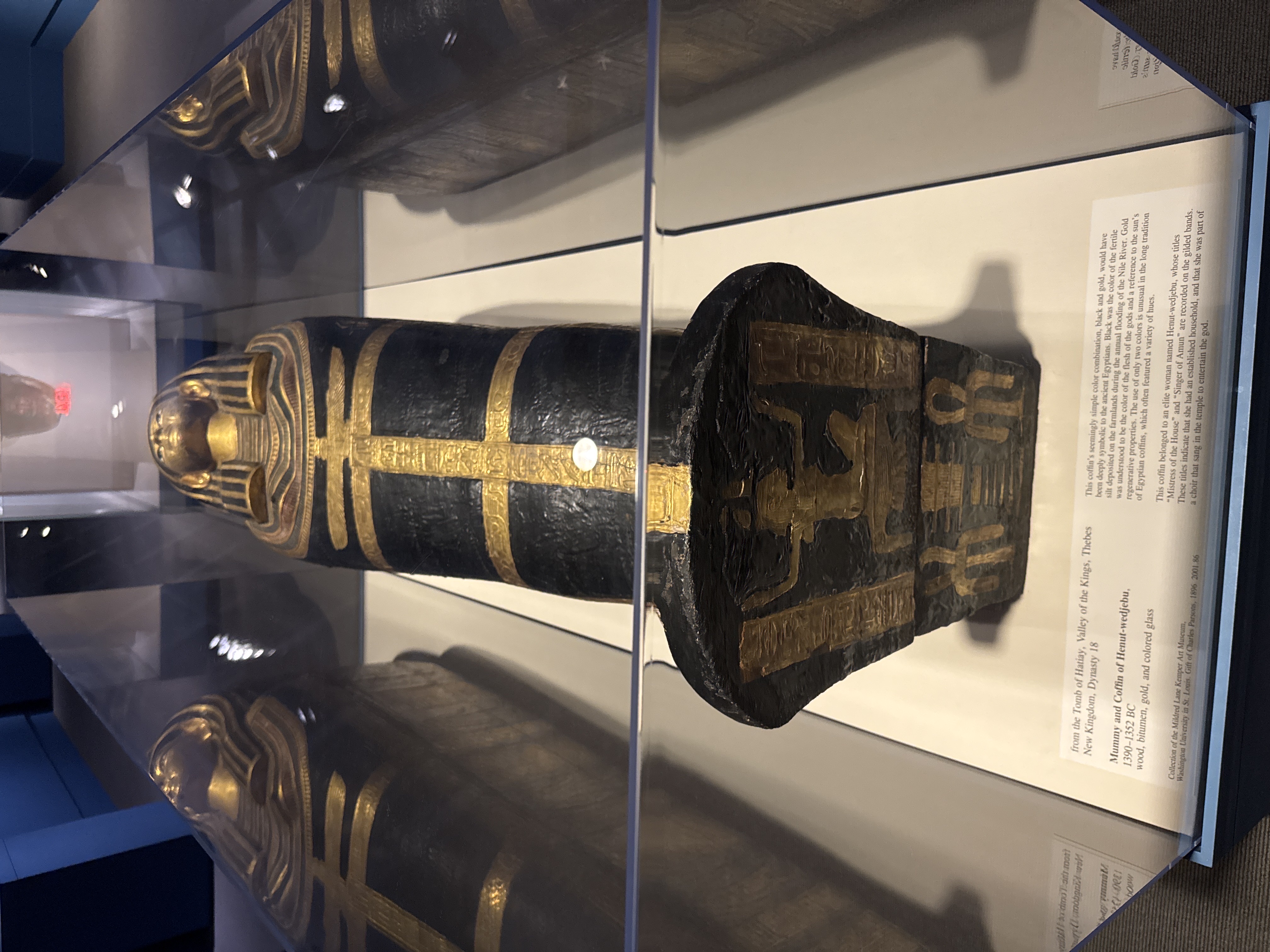
Mummy and Coffin of Henut-wedjebu
This is the mummy and coffin of Henut-wedjebu, an Egyptian noblewoman who sang in temples. She lived around 1390–1352 BCE. The black and gold coffin shows her importance and beliefs about the afterlife.
What is it?
This is a mummy and its coffin from ancient Egypt. The mummy is the preserved body of Henut-wedjebu, wrapped in linen bandages. The coffin is made of wood, painted black and gold. The gold decorations symbolize the sun, rebirth, and the gods. The black color represents the fertile soil of the Nile, which meant new life.
Who used it?
Henut-wedjebu was a noblewoman. She had the titles "Singer of Horus" and "Singer of Amun." This means she performed music in temples for religious ceremonies. Her coffin shows she was wealthy and important.
When and where?
Henut-wedjebu lived during the New Kingdom, around 1390–1352 BCE. She was buried in the Valley of the Kings near Thebes (modern Luxor, Egypt). This area was used for royal and noble burials.
What does it tell us?
The coffin tells us that Henut-wedjebu was a person of high status. The black and gold colors and the fine decorations show that she could afford expensive materials. Her titles show that women could hold important religious roles in ancient Egypt. The mummy and coffin also show the Egyptian belief in the afterlife and the importance of preserving the body.
Compared to today
Today, when people die, they are often buried in a simple coffin or cremated. Ancient Egyptians spent a lot of time and money on mummification and elaborate coffins because they believed the body needed to be preserved for the afterlife.
Connections
- Ancient Egypt
- Mummification
- Henut-wedjebu
- New Kingdom
- Valley of the Kings
- Death and Afterlife
- Religion and Faith
Next to find
- A shabti figurine from the same tomb
- A statue of an Egyptian god or goddess
- Another mummy from a different time period
- A piece of jewelry that Henut-wedjebu might have worn
赫努特-维吉布的木乃伊与棺材
这是赫努特-维吉布的木乃伊和棺材,她是一位在寺庙唱歌的古埃及贵族女性,生活在约公元前1390-1352年。黑金配色的棺材显示了她的重要性和对来世的信仰。
这是什么?
这是古埃及的木乃伊及其棺材。木乃伊是赫努特-维吉布经过防腐处理的尸体,用亚麻布绷带包裹。棺材由木头制成,涂成黑色和金色。金色的装饰象征着太阳、重生和神灵。黑色代表尼罗河肥沃的土壤,意味着新生命。
谁使用了它?
赫努特-维吉布是一位贵族女性。她拥有“霍鲁斯的歌者”和“阿蒙的歌者”的称号。这意味着她在寺庙中为宗教仪式表演音乐。她的棺材显示她富有且重要。
何时何地?
赫努特-维吉布生活在新王国时期,约公元前1390-1352年。她被埋葬在底比斯(今埃及卢克索)附近的帝王谷。这个区域用于王室和贵族的墓葬。
它告诉了我们什么?
棺材告诉我们赫努特-维吉布地位很高。黑色和金色的配色以及精美的装饰表明她能够负担昂贵的材料。她的称号表明女性在古埃及可以担任重要的宗教角色。木乃伊和棺材也显示了埃及人对来世的信仰以及保存尸体的重要性。
与今天比较
今天,人死后通常被埋葬在简单的棺材里或火化。古埃及人花费大量时间和金钱进行木乃伊制作和 elaborate 棺材,因为他们相信身体需要保存以便来世使用。
关联
接下来寻找
- 同一墓葬中的沙布提俑
- 一尊埃及神或女神的雕像
- 来自不同时期的另一具木乃伊
- 赫努特-维吉布可能佩戴过的珠宝