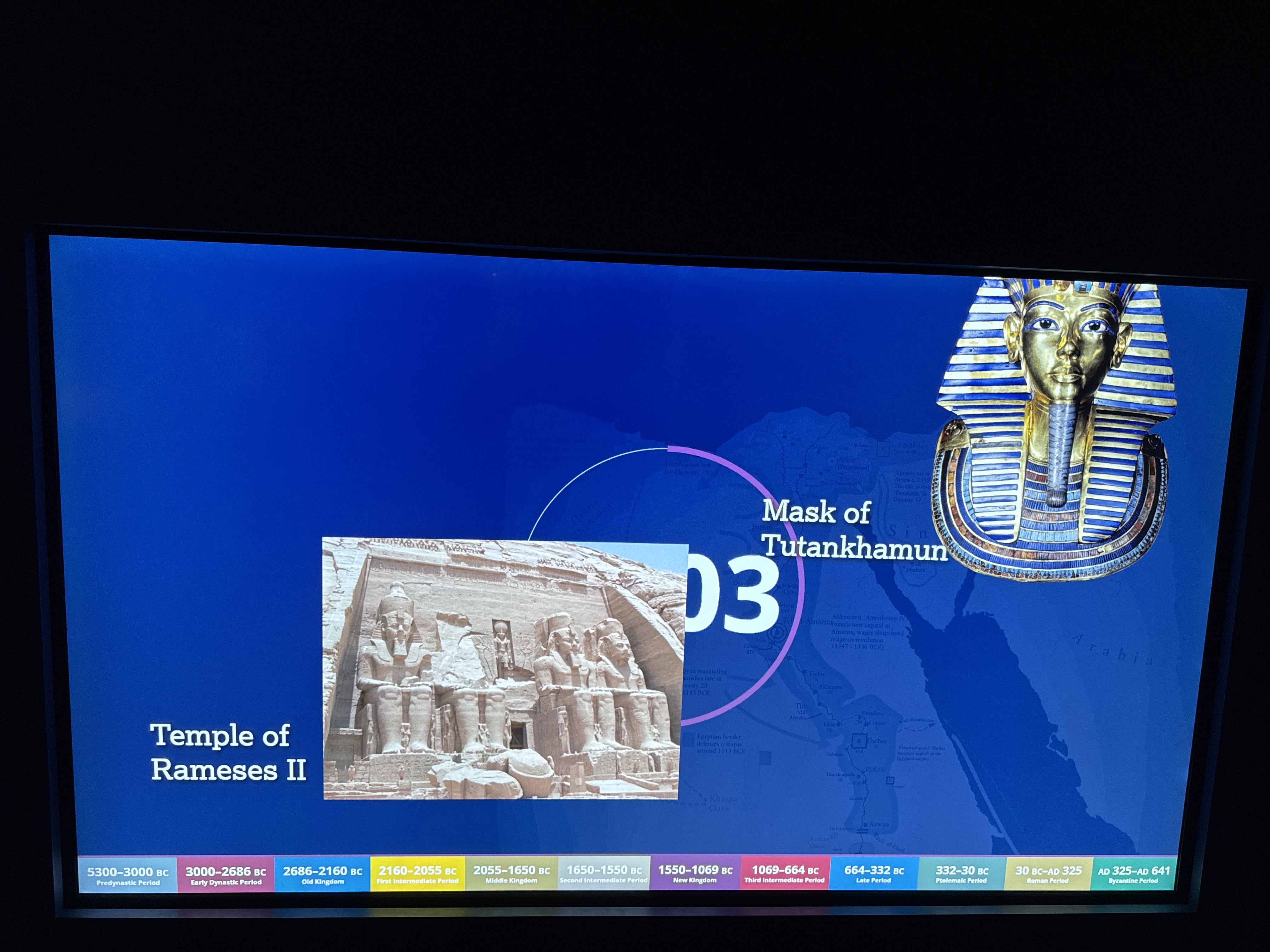
Abu Simbel Temple and Tutankhamun's Mask
The Abu Simbel temple was built by Pharaoh Ramesses II to show his power, and Tutankhamun's gold mask was made to protect the young king in the afterlife.
What is it?
You captured two famous ancient Egyptian artifacts: the Abu Simbel temple (also called the Temple of Ramesses II) and the gold mask of Tutankhamun. The temple is a huge rock-cut monument in southern Egypt, built by Pharaoh Ramesses II in the 13th century BCE. The mask is a stunning gold funeral mask from the tomb of the young Pharaoh Tutankhamun, discovered in 1922.
Who used it?
The temple was used by Ramesses II to celebrate his victories and to honor the gods. It was also a symbol of his power over Nubia. The mask was placed on Tutankhamun's mummy to protect him in the afterlife and to show his royal status.
When and where?
The Abu Simbel temple was built around 1250 BCE in Nubia, southern Egypt. Tutankhamun ruled around 1323 BCE, and his mask was made for his tomb in the Valley of the Kings. In the 1960s, the Abu Simbel temple was moved to higher ground to save it from flooding caused by the Aswan Dam.
What does it tell us?
These artifacts show that ancient Egyptian pharaohs were seen as gods on earth. They built huge monuments and were buried with treasures to ensure their journey to the afterlife. The mask's fine goldwork and the temple's massive statues reveal the skill of Egyptian artists and the importance of religion.
Compared to today
Today, leaders might build museums or skyscrapers to show their power, but ancient pharaohs built temples and tombs. We still use gold for special jewelry, but not for masks. The idea of an afterlife is still important in many religions.
Connections
Next to find
- A statue of an Egyptian god or goddess
- A piece of jewelry from ancient Egypt
- A model of an Egyptian pyramid
- An artifact from another ancient civilization, like Mesopotamia
阿布辛拜勒神庙与图坦卡蒙面具
阿布辛拜勒神庙由法老拉美西斯二世建造以显示他的权力,图坦卡蒙的黄金面具则用于保护年轻国王在来世的生活。
这是什么?
你捕捉了两件著名的古埃及文物:阿布辛拜勒神庙(也称拉美西斯二世神庙)和图坦卡蒙的黄金面具。神庙是位于埃及南部的一座巨大的岩石切割纪念碑,由法老拉美西斯二世于公元前13世纪建造。面具是来自年轻法老图坦卡蒙陵墓的华丽黄金葬礼面具,于1922年发现。
谁使用了它?
神庙被拉美西斯二世用于庆祝胜利和敬奉神灵,也是他统治努比亚权力的象征。面具被放在图坦卡蒙的木乃伊上,以在来世保护他并显示他的王室地位。
何时何地?
阿布辛拜勒神庙建于公元前1250年左右,位于埃及南部的努比亚。图坦卡蒙统治时期约为公元前1323年,他的面具是为他在帝王谷的陵墓制作的。20世纪60年代,阿布辛拜勒神庙被迁移到更高的地方,以避免阿斯旺大坝造成的洪水淹没。
它告诉我们什么?
这些文物表明古埃及法老被视为地上的神。他们建造巨大的纪念碑,并随葬珍宝以确保来世之旅。面具精细的金工和神庙巨大的雕像揭示了埃及艺术家的技艺和宗教的重要性。
与今天相比
今天的领导人可能会建造博物馆或摩天大楼来显示权力,但古代法老建造神庙和陵墓。我们仍然用黄金制作特殊首饰,但不用作面具。来世的观念在许多宗教中仍然重要。
联系
下一步寻找
- 一尊埃及神或女神的雕像
- 一件古埃及珠宝
- 一个埃及金字塔模型
- 来自另一个古代文明(如美索不达米亚)的文物