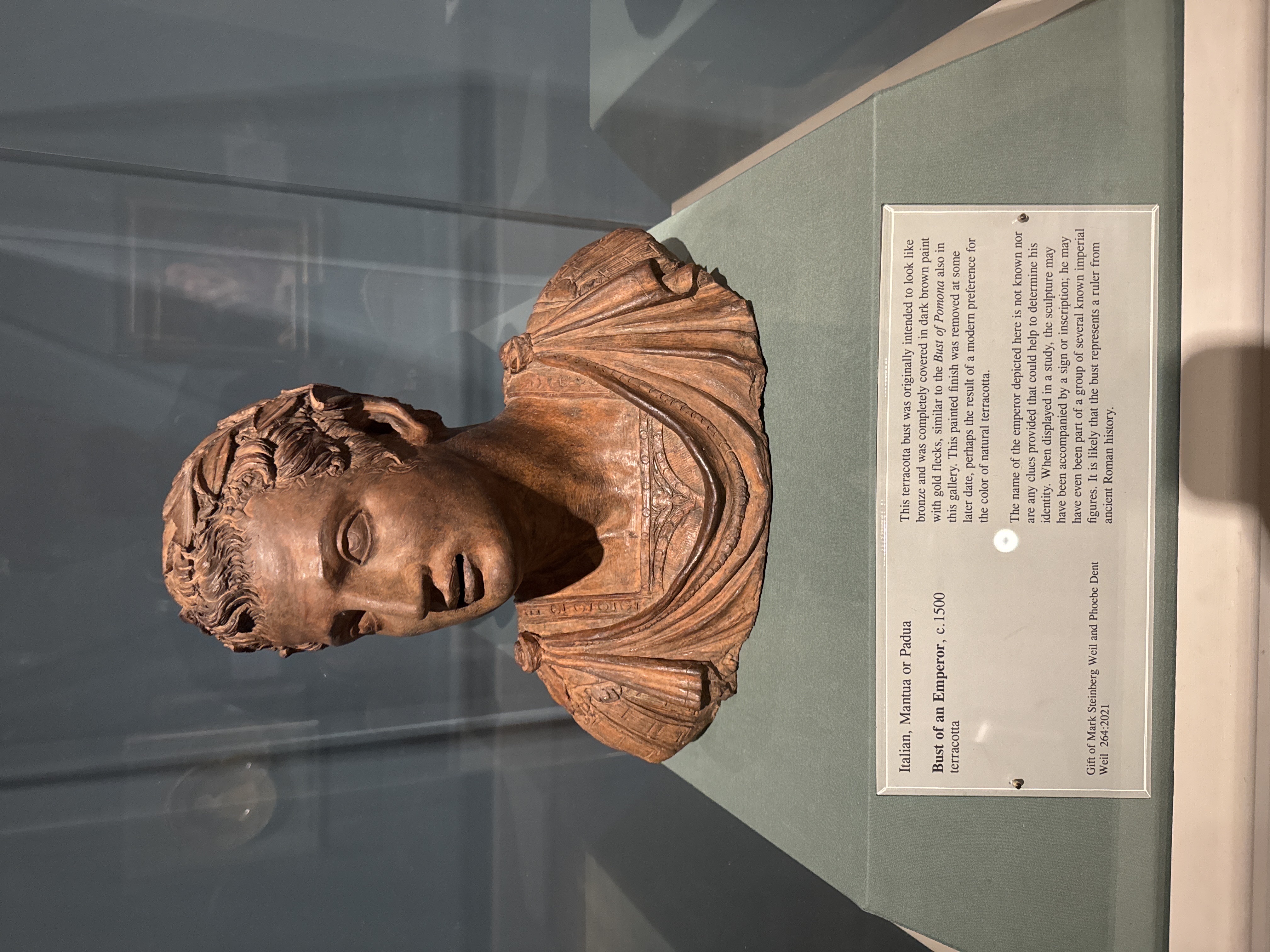
Terracotta Portrait Bust of a Roman Emperor
This is a clay bust of a Roman emperor, made in Italy around 1500. It was painted to look like bronze, but later the paint was removed so you can see the natural clay.
What is it?
This is a portrait bust made of terracotta (baked clay). It shows a Roman emperor, but we don't know exactly which one. The bust was made in Mantua or Padua, Italy, around the year 1500. At that time, artists were very interested in ancient Roman art and often made copies or new works in the Roman style.
Who used it?
This bust was probably made for a wealthy person who admired ancient Rome. It might have been displayed in a study or a collection of antiquities. People who collected such busts wanted to show they were educated and appreciated classical culture.
When and where?
It was made around 1500 in northern Italy, either in Mantua or Padua. This was the Renaissance period, when artists and scholars looked back to ancient Greece and Rome for inspiration.
What does it tell us?
This bust tells us that people in the Renaissance admired Roman emperors and wanted to have their portraits. The fact that it was painted to look like bronze shows that bronze was considered more valuable, but the clay was also appreciated for its natural look. The removal of the paint might reflect a modern taste for seeing the material as it is.
Compared to today
Today, we often make copies of famous sculptures using materials like plaster or resin. But in the Renaissance, artists made new works that looked ancient. This bust is like a bridge between ancient Rome and the Renaissance.
Connections
Next to find
- Look for another Renaissance bust that imitates ancient Roman style.
- Find a bronze statue from the same period and compare the materials.
- Search for a portrait of a specific Roman emperor, like Augustus or Hadrian.
罗马皇帝陶土肖像胸像
这是一尊罗马皇帝的陶土胸像,大约1500年在意大利制作。它被涂成青铜的样子,但后来颜料被去除,露出了天然的陶土。
这是什么?
这是一尊用陶土(烧制的粘土)制作的肖像胸像。它表现的是一位罗马皇帝,但我们不确定具体是哪一位。这尊胸像大约在1500年制作于意大利的曼图亚或帕多瓦。那时,艺术家对古罗马艺术非常感兴趣,经常制作罗马风格的新作品或复制品。
谁使用它?
这尊胸像可能是为一位仰慕古罗马的富人制作的。它可能被陈列在书房或古董收藏中。收藏这类胸像的人希望展示自己受过教育并欣赏古典文化。
何时何地?
它制作于大约1500年的意大利北部,曼图亚或帕多瓦。这是文艺复兴时期,艺术家和学者们回顾古希腊和罗马以寻找灵感。
它告诉我们什么?
这尊胸像告诉我们,文艺复兴时期的人们仰慕罗马皇帝,并希望拥有他们的肖像。它被涂成青铜色的事实表明青铜被认为更有价值,但陶土的自然外观也受到欣赏。颜料的去除可能反映了现代人对材料自然质感的偏好。
与今天相比
今天,我们经常用石膏或树脂等材料复制著名雕塑。但在文艺复兴时期,艺术家制作看起来古老的新作品。这尊胸像就像是古罗马和文艺复兴之间的桥梁。
关联
接下来寻找
- 寻找另一件模仿古罗马风格的文艺复兴胸像。
- 找一件同时期的青铜雕像,比较材料。
- 搜索一位特定罗马皇帝的肖像,比如奥古斯都或哈德良。