Egyptian Funerary Artifacts
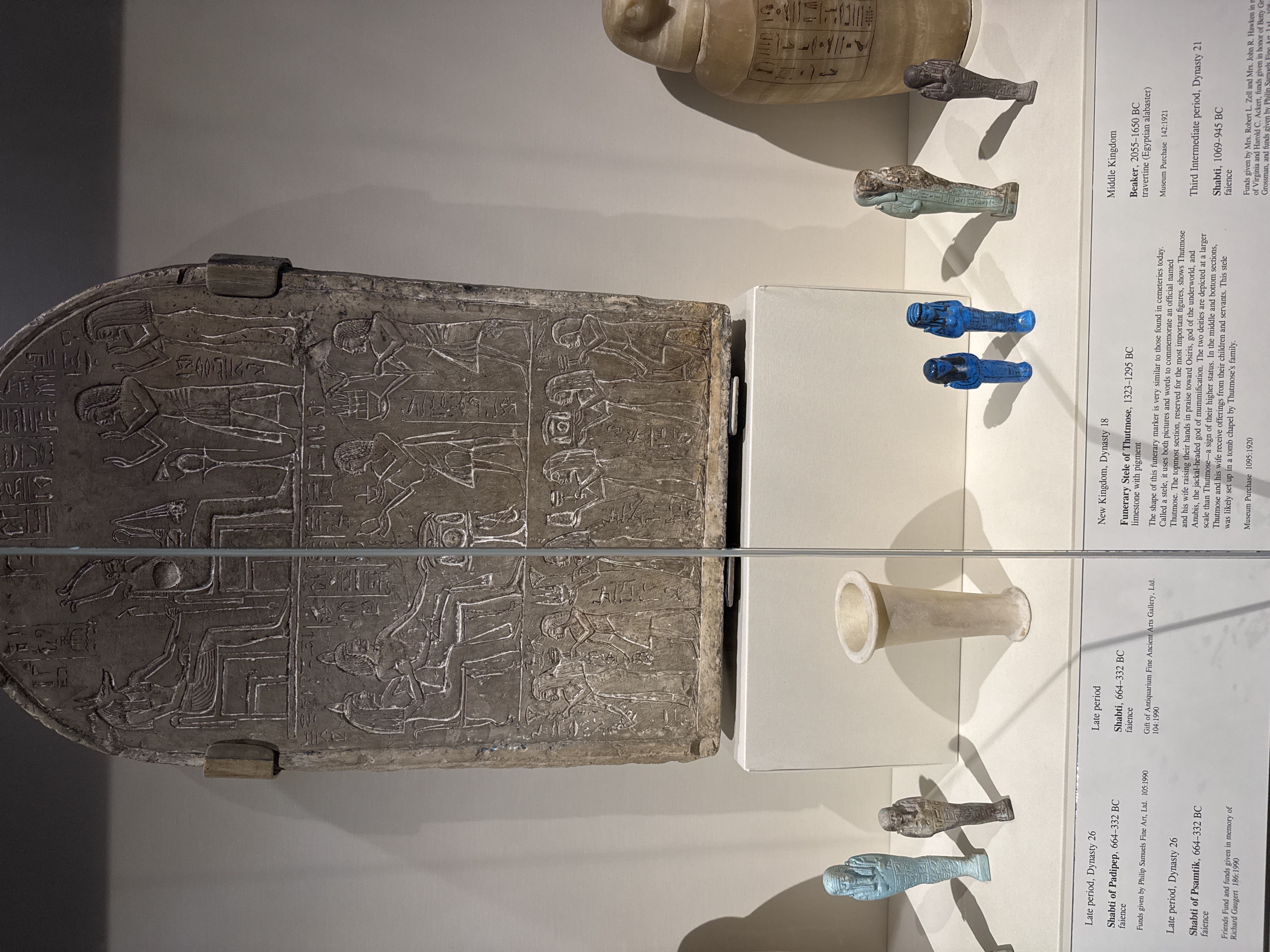
These are ancient Egyptian objects from a tomb: a stone stela for a man named Thutmose, small shabti figures to work for him in the afterlife, and a jar for perfume.
What is it?
This photo shows several objects from ancient Egypt that were placed in tombs. In the center is a funerary stela (a stone slab) for a man named Thutmose. It dates to the 18th Dynasty of the New Kingdom, around 1332–1295 BCE. The scene on the stela shows rituals for Thutmose's funeral and his interaction with gods.
Below and around the stela are small shabti figures. These statues were buried with pharaohs and nobles. They were meant to work for the person in the afterlife, doing any hard labor. Most are made of ceramic, some painted blue or green to represent the life-giving Nile.
On the right is a slender jar from the Middle Kingdom (about 2055–1650 BCE). It was used to store perfume or cosmetics in the tomb.
Who used it?
These objects were made for Thutmose, an Egyptian official or noble. The shabtis and jar were also for him. The ancient Egyptians believed in an afterlife where the soul would live on. They filled tombs with objects the person might need.
When and where?
These artifacts come from ancient Egypt, along the Nile River. The stela is from the New Kingdom (about 1550–1070 BCE), specifically the 18th Dynasty. The jar is older, from the Middle Kingdom (about 2055–1650 BCE). The shabtis are likely from the New Kingdom as well.
What does it tell us?
These objects show that the ancient Egyptians believed strongly in life after death. They prepared carefully for the afterlife by including food, tools, and servants (shabtis). The stela shows religious rituals and the importance of gods. The blue and green colors on shabtis symbolize the Nile's water, which was essential for life.
Compared to today
Today, we might put photos or mementos of loved ones in our homes. Ancient Egyptians put objects like these in tombs to help the person in the next world. We still remember people after they die, but we don't usually bury them with servants or perfume jars.
Connections
Next to find
- A mummy or coffin from ancient Egypt
- A different kind of shabti figure (maybe made of wood or faience)
- An Egyptian object from the Old Kingdom (like a pyramid model)
- A statue of an Egyptian god like Anubis or Osiris
埃及丧葬文物
这些是来自古埃及墓葬的物品:一块属于图特摩斯的石碑、在来世为他工作的小夏比提雕像,以及一个香水瓶。
这是什么?
这张照片展示了古埃及墓葬中的几件物品。中央是一块丧葬石碑,属于一位名叫图特摩斯的人。它属于新王国第18王朝,约公元前1332–1295年。石碑上的场景描绘了图特摩斯葬礼的仪式以及他与神明的互动。
石碑下方和周围是小型夏比提雕像。这些雕像与法老和贵族一起下葬,旨在来世为死者承担劳役。大多数是陶瓷材质,有些涂成蓝色或绿色,象征赋予生命的尼罗河。
右侧是一个细长的瓶子,来自中王国时期(约公元前2055–1650年),用于在墓中存放香水或化妆品。
谁使用它?
这些物品是为图特摩斯制作的,他是一位埃及官员或贵族。夏比提和瓶子也是为他准备的。古埃及人相信来世,灵魂会继续生活。他们在墓中装满死者可能需要的物品。
何时何地?
这些文物来自古埃及,沿尼罗河地区。石碑属于新王国(约公元前1550–1070年),特别是第18王朝。瓶子更古老,来自中王国(约公元前2055–1650年)。夏比提很可能也属于新王国。
它告诉我们什么?
这些物品表明古埃及人坚信死后生命。他们精心为来世准备,包括食物、工具和仆人(夏比提)。石碑展示了宗教仪式和神的重要性。夏比提上的蓝色和绿色象征尼罗河的水,对生命至关重要。
与今天比较
今天,我们可能会在家中放置亲人的照片或纪念品。古埃及人则将此类物品放入墓中,以帮助死者在另一个世界生活。我们仍然在死后纪念亲人,但通常不会埋葬仆人或香水瓶。
关联
下一步寻找
- 一具来自古埃及的木乃伊或棺材
- 另一种夏比提雕像(可能是木制或彩陶)
- 一件古王国时期的埃及物品(如金字塔模型)
- 一尊埃及神像,如阿努比斯或奥西里斯