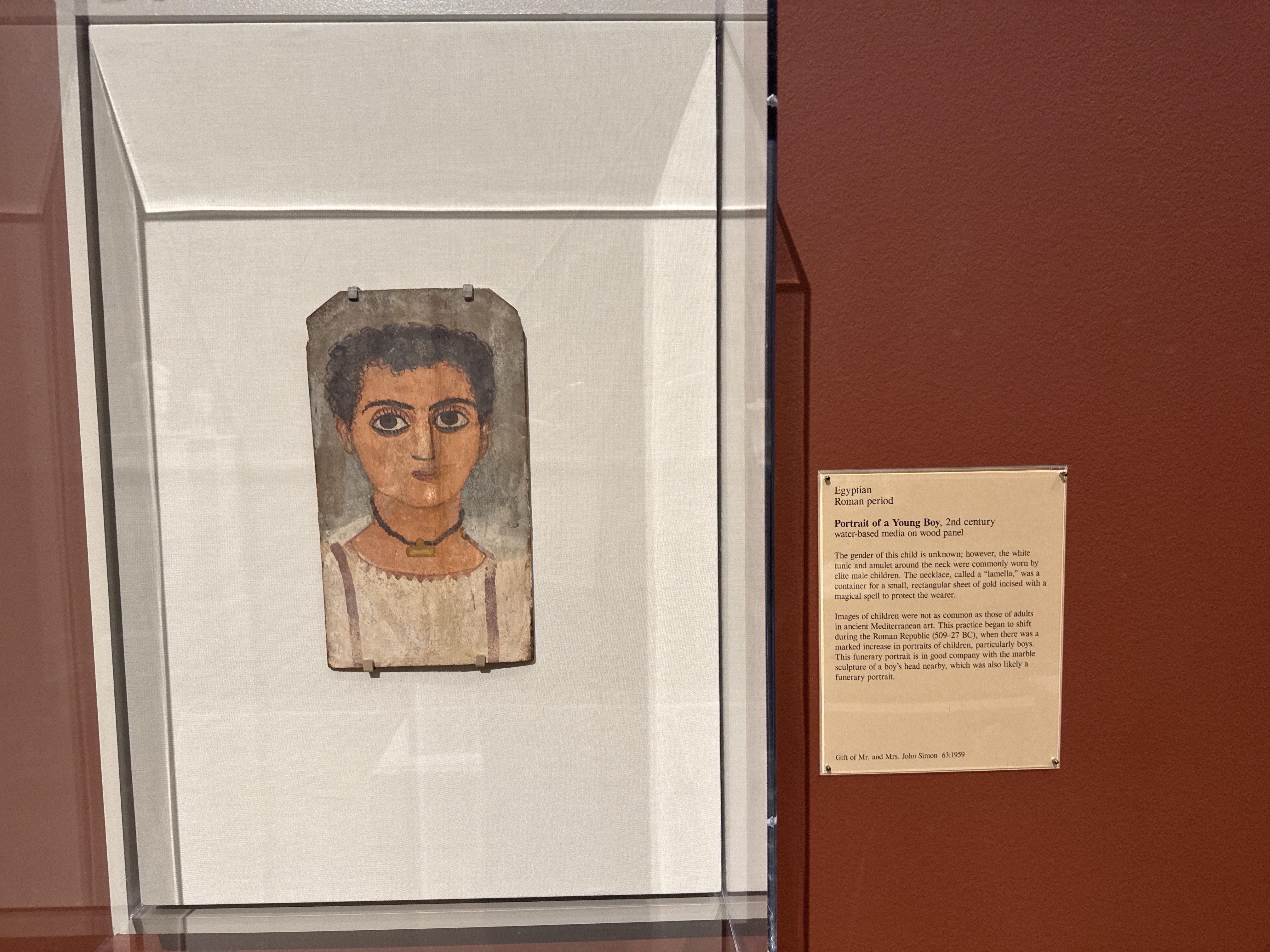
Roman-Egyptian Child Mummy Portrait
This is a portrait of a Roman-Egyptian boy painted on wood around 150 AD. It was placed on his mummy so people would remember his face.
What is it?
This is a painting of a young boy from Roman Egypt, made around the 2nd century AD. The artist used water-based paints on a wooden board. The boy wears a white tunic and a special necklace called a bulla, which was worn by Roman children to protect them from bad luck. We don't know his name, but his portrait was made to be placed on his mummy after he died.
Who used it?
In Roman Egypt, people from wealthy families would have portraits like this painted while they were alive or soon after death. The portrait was attached to the mummy wrappings over the face. This way, the person's identity would be preserved forever. Children and adults both had these portraits.
When and where?
This portrait was made in Egypt between about 100 and 300 AD, when Egypt was part of the Roman Empire. This style of mummy portrait is called "Fayum mummy portraits" because many were found in the Fayum region of Egypt.
What does it tell us?
This portrait tells us that people in Roman Egypt cared about remembering the dead. The boy's white tunic and bulla show he was a Roman citizen. The painting style mixes Egyptian traditions (mummies) with Roman art (realistic portraits). It shows how cultures blended in the ancient world.
Compared to today
Today we take photos of people to remember them. Back then, they painted portraits on wood. Both are ways to keep a person's memory alive.
Connections
Next to find
- Look for another Fayum mummy portrait in a museum. Compare the clothing and hairstyles.
- Find a Roman bulla necklace in a museum or online. What does it look like?
- Explore how ancient Egyptians made mummies. Why did they preserve bodies?
罗马-埃及儿童木乃伊肖像
这是一幅公元150年左右画在木板上的罗马-埃及男孩肖像。它被放在他的木乃伊上,以便人们记住他的面孔。
这是什么?
这是一幅来自罗马埃及的小男孩的绘画,创作于公元2世纪左右。艺术家在木板上使用了水溶性颜料。男孩穿着白色束腰长袍,戴着一种特殊的项链,叫做护身符(bulla),罗马儿童佩戴它以保护他们免受厄运。我们不知道他的名字,但他的肖像画是为了在他死后放在木乃伊上而制作的。
谁使用它?
在罗马埃及,富裕家庭的人会在生前或死后不久绘制这样的肖像。肖像被附在木乃伊包裹物上,覆盖在脸部。这样,死者的身份就会被永远保存。儿童和成人都有这样的肖像。
何时何地?
这幅肖像制作于公元100年至300年之间的埃及,当时埃及是罗马帝国的一部分。这种风格的木乃伊肖像被称为"法尤姆木乃伊肖像",因为许多是在埃及的法尤姆地区发现的。
它告诉我们什么?
这幅肖像告诉我们,罗马埃及的人们关心纪念死者。男孩的白色束腰长袍和护身符表明他是罗马公民。绘画风格融合了埃及传统(木乃伊)和罗马艺术(写实肖像)。它展示了古代世界文化的融合。
与今天相比
今天我们拍照来记住人们。那时,他们在木板上画肖像。两者都是保持记忆的方式。
关联
下一步寻找
- 在博物馆中寻找另一幅法尤姆木乃伊肖像。比较服装和发型。
- 在博物馆或网上找到罗马护身符项链。它长什么样?
- 探索古埃及人如何制作木乃伊。他们为什么要保存尸体?