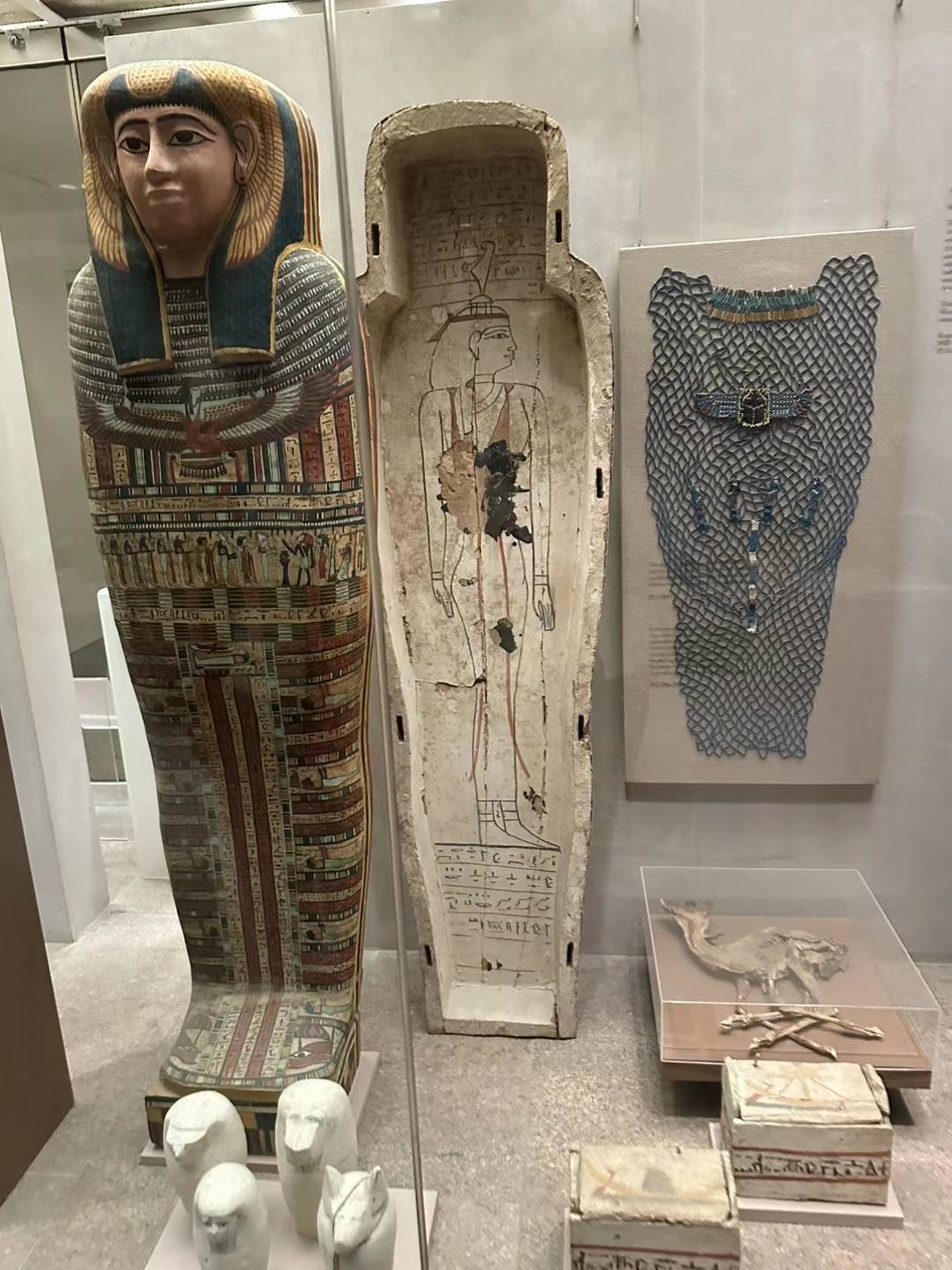
Mummy Coffin and Funerary Objects
This is an ancient Egyptian mummy coffin with colorful paintings and hieroglyphs, along with a beaded net and small statues called shabtis that were placed in the tomb to help the dead person in the afterlife.
What is it?
You captured a mummy coffin (also called a sarcophagus) from ancient Egypt. It is a wooden box painted with bright colors and covered with hieroglyphs—picture writing that tells the name of the dead person and includes magic spells to protect them. Next to the coffin, you saw a beaded net that was placed over the mummy's body, and several small statues called shabtis. These objects were all placed in a tomb to help the dead person in the afterlife.
Who used it?
This coffin was made for an important person, maybe a wealthy official or a priest. In ancient Egypt, only rich people could afford such a fancy coffin with paintings and gold. The shabtis were like little servants—the Egyptians believed they would come to life and do any hard work for the dead person in the next world.
When and where?
This coffin is from ancient Egypt, probably from around 1500 BCE, during the New Kingdom or a bit earlier. It might have come from the city of Thebes (modern Luxor), where many tombs and temples are located. The Egyptians believed that if the body was preserved and placed in a coffin like this, the person's soul would live forever.
What does it tell us?
This coffin tells us that the ancient Egyptians thought a lot about what happens after death. They believed in an afterlife where the soul would need a body, food, and helpers. The hieroglyphs on the coffin are spells from the Book of the Dead, a guide to help the dead person pass through dangers in the underworld. The beaded net was meant to protect the mummy, and the shabtis were ready to work. All these objects show how seriously they took the journey to the afterlife.
Compared to today
Today, when someone dies, we might bury them in a simple coffin or cremate them. We don't usually put food or servants in the grave. But we still have ceremonies to remember the person and help their spirit. In some cultures, people still leave offerings at graves. The idea of helping the dead in the next world is not so different from what Egyptians did—just the way they did it was very elaborate!
Connections
Next to find
- A real mummy (wrapped in linen) to see how the body was preserved.
- A canopic jar—a jar used to store the dead person's organs.
- A copy of the Book of the Dead to read some of the spells.
- Another shabti from a different time period to compare.
木乃伊棺椁与陪葬品
这是一具古埃及木乃伊棺椁,上面有彩色绘画和象形文字,还有一张珠饰网和叫做沙布提的小雕像,放在墓中帮助死者在来世生活。
这是什么?
你拍摄了一具古埃及的木乃伊棺椁(也叫石棺)。它是一个木制的盒子,涂有鲜艳的颜色,并覆盖着象形文字——一种图画文字,写着死者的名字,并包含保护他们的魔法咒语。在棺椁旁边,你看到了一张珠饰网,曾覆盖在木乃伊身上,还有几个小雕像,叫做沙布提。这些物品都放在墓中,帮助死者在来世生活。
谁使用它?
这具棺椁是为一个重要人物制作的,可能是一位富有的官员或祭司。在古埃及,只有有钱人才能买得起这样精美的棺椁,上面有绘画和金色。沙布提就像小仆人——埃及人相信它们会活过来,为死者在另一个世界做任何辛苦的工作。
何时何地?
这具棺椁来自古埃及,可能大约在公元前1500年,属于新王国时期或稍早。它可能来自底比斯城(今卢克索),那里有许多陵墓和神庙。埃及人相信,如果尸体被保存并放在这样的棺椁里,死者的灵魂就会永生。
它告诉我们什么?
这具棺椁告诉我们,古埃及人非常关心死后会发生什么。他们相信来世,灵魂需要身体、食物和帮手。棺椁上的象形文字是《死者之书》中的咒语,是一本帮助死者安全通过冥界险境的指南。珠饰网用来保护木乃伊,沙布提则随时准备工作。所有这些物品都显示出他们对来世之旅的重视。
与今天相比
今天,当有人去世时,我们可能会把他们埋在简单的棺材里或火化。我们通常不会在墓中放食物或仆人。但我们仍然有仪式来纪念死者并帮助他们的灵魂。在一些文化中,人们仍然在墓前留下祭品。帮助死者在另一个世界的想法与埃及人所做的并没有太大不同——只是他们的方式非常讲究!
关联
下一步寻找
- 一具真正的木乃伊(用亚麻布包裹),看看尸体是如何保存的。
- 一个卡诺匹斯罐——用来存放死者器官的罐子。
- 一本《死者之书》的副本,读一些咒语。
- 另一个来自不同时期的沙布提,进行比较。